


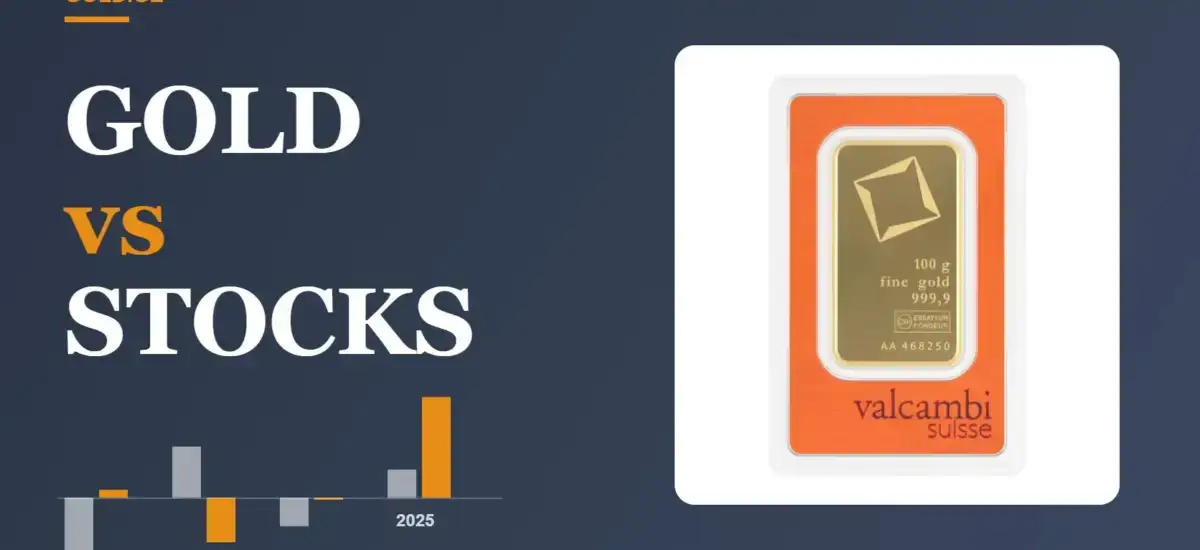
Lately we hear this a lot at the counter: “Stocks are up this year and gold is down. Should I have put the money into shares instead?” It’s a fair question. Here is an honest look at what each one actually does for your savings, and why you may not need to pick just one.
A share is a piece of a company. When the company grows and makes money, the share price rises, and often it pays a dividend too. Gold is nobody’s piece of anything. It produces no profit and pays no dividend. So measuring the two with the same ruler is not quite fair.
Put simply: stocks are there to grow your wealth. Gold is there so that a bad year doesn’t take too big a bite out of it.
01In normal years, stocks come out ahead
There’s no point pretending otherwise. The S&P 500, with dividends reinvested, returned 26% in 2023, 25% in 2024 and 18% in 2025. As of 13 November, 2026 is a positive year as well, up about 11%.
2026 has been hard on gold. An ounce hit a record $5,589 on 28 January; today it trades around $3,873, roughly 31% below that peak. Anyone who bought at the start of the year is still under water.
Keep that in mind before you call gold a “safe” asset. Its price moves too, sometimes a lot. The live gold price on our site refreshes about every 10 seconds.
02When markets fall, the picture flips
Gold earns its place when stocks drop. In 2008, at the height of the financial crisis, the S&P 500 lost 37% including dividends. Gold rose about 5% that same year. In 2022 stocks lost 18% while gold barely moved.
BullionVault’s historical data shows that, until 2022, gold rose in every year that US stocks fell by more than 10% including dividends. Those are the years people hold it for.
It works the other way too. In 2013 gold fell 28% while stocks gained 32%. So gold doesn’t replace stocks; it balances them, often moving at a different time and in a different direction.
03Gold vs stocks, year by year
| Year | S&P 500 (with dividends) | Gold (in USD) |
|---|---|---|
| 2008 | −36.8% | +4.9% |
| 2013 | +32.3% | −28.3% |
| 2022 | −18.2% | −0.8% |
| 2025 | +17.7% | +63.7% |
| 2026 (to 13 Nov) | +11.5% | −10.3% |
Sources: ChartRow, S&P 500 and ChartRow, gold (based on the SPY and GLD funds); BullionVault. Past performance does not predict future returns.
The interesting rows are the ones where one asset falls and the other holds or rises. The two rarely crash together, which is exactly why many investors keep both.
04Large sums: where the real risk sits
Once you’re talking about six figures or more, returns aren’t the only question. What you actually own matters as well.
Shares usually sit with a broker, often in an account abroad. That’s convenient: you can buy or sell in seconds and fees are low. But what you hold is an entry in an account, and a lot depends on the broker, the bank and another country’s rules.
Physical gold is nobody’s liability. A 999.9 bar is yours wherever it’s kept, and its value doesn’t depend on any company staying in business. The trade-off is that keeping it safe is your job. More on that here: how to store gold.
One more point if your savings are in lari: both US stocks and gold are priced in dollars, so if the lari weakens, both get more expensive in lari terms.
05The costs people mention less often
Buying physical gold has a cost and we won’t hide it. A bar sells above the market value of the metal, and the gap is wider on small bars. Today, 16 November, our 1 g C. Hafner bar costs 20.5% over the metal value, while the 100 g Royal Mint Britannia bar costs just 3.8% over.
When you sell, you get the market price minus a margin. Gold.ge buys back only bars and coins that were bought from us. We don’t buy jewellery or gold bought elsewhere.
Stocks have costs too: broker commissions, often currency conversion, and account fees. They’re usually lower, but they aren’t zero.
06Gold or stocks? In practice, often both
People with substantial savings rarely put everything in one basket. A common split looks like this:
- Stocks for the part that needs to grow and whose swings you can sit through for years.
- Gold for the part that has to survive a bad year. Don’t expect income from it; its job is protection.
- Buy gold in stages. Spreading purchases over a few months gives you an average price and takes away the pressure of timing the market.
- Bigger bars for bigger sums. 1 kg bars are available on order and collected in store. Companies can buy against an invoice and pay by bank transfer.
How much to hold in gold depends on your goals and time horizon. This article is for information only and is not investment advice.
→ Gold bars · Gold vs bank deposit · Gold during a crisis
07Questions we get asked most
Is gold a better investment than stocks?
It depends on the period. In normal years stocks return more. In crisis years such as 2008 and 2022, gold held up far better. That’s why many investors own both.
Gold is about 31% below its peak. Is it worth buying now?
Nobody can predict the price, and we don’t give investment advice. Many people buy in stages over several months at times like this. More here: is it too late to buy gold?
Stocks pay dividends. What does gold give me?
No income at all. What you get is an asset that doesn’t depend on any company or bank and often holds its value when stocks fall.
What if I need to sell my gold?
Gold.ge buys back bars and coins bought from us, at the market price minus a margin. Contact the store for today’s price. We don’t buy jewellery or gold bought elsewhere.
Can a company buy gold?
Yes. We issue the company an invoice and payment is made by bank transfer.
Keep part of your savings in gold
Bars and coins online or at our stores in Tbilisi: Galleria Tbilisi (2/4 Shota Rustaveli Ave) and Radisson Blu Iveria. Pay online and the price locks the moment you pay; with Keepz there’s no commission.
Gold barsGold price todayContact