


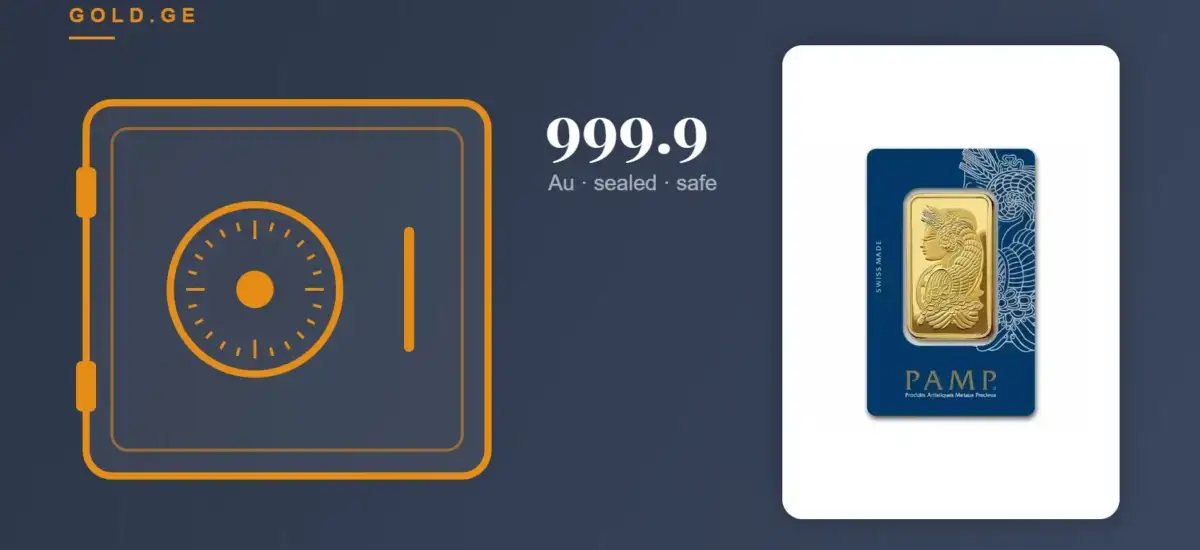
You’ve bought gold. Now where do you keep it: a home safe, a bank box, or both? Here are the upsides and risks of each option, and what we tell our customers depending on how much they hold.
After buying a bar, the first question is often not about price but this: “Is it safe to keep at home?” There is no single answer. A couple of grams bought as a gift is a very different thing from half a kilo of savings.
Below is what to think about so your gold looks exactly the same in twenty years as it did the day you bought it.
01Gold doesn’t age. The packaging does
999.9 gold does not oxidise or tarnish. In twenty years it will look the way it does today. So the care goes into everything around it: the certificate card, the coin capsule, the receipt and, of course, security.
Small bars come in a sealed card: CertiPAMP for PAMP, CertiCard for Valcambi. Leave it sealed. The bar stays free of scratches and fingerprints, and it is easier to verify later. Keep coins in their capsules and never clean them: cleaning damages the surface.
Keep the receipt or invoice somewhere other than the gold. Gold.ge buys back the bars and coins it sold, and proof of purchase makes that simpler.
02At home: convenient, with a few rules
The big advantage is that your gold is always within reach and you pay no rent. It takes up very little space: gold is extremely dense, so one kilo is about 52 cubic centimetres and fits in the palm of your hand.
The risks are just as obvious: theft, fire, and forgetting where you hid it. So:
- Bolt the safe to a wall or the floor. A drawer, a wardrobe or “behind the books” is not a safe.
- Don’t keep everything in one place. Splitting it between two or three spots lowers the risk.
- The fewer people who know, the better. Don’t post photos of your gold online or tell everyone about the purchase.
- Insurance. If your home is insured, ask your insurer whether the policy covers precious metals and up to what limit.
“Clever” hiding places like the freezer, under the mattress or a shoebox are well known to burglars too. You are better off spending money on a good safe than time on inventing a hiding spot.
03A bank box: when the amount is serious
Once you are talking tens of thousands of lari, a bank safe deposit box is the logical choice. The vault is guarded, and the risk of theft or fire is far lower than at home.
Three things to know, though. First, you pay rent every year, and the price depends on the size of the box. Second, you can usually reach your gold only during banking hours. Third, what sits in the box is not a deposit: ask the bank whether the contents are insured and on what terms.
Check the terms and the price with your bank in advance.
A box is rented under a contract, so find out two things up front: who else can be given access (a spouse or a grown-up child, say) and what happens if the rental period runs out and you forget to renew it.
04What we suggest, by amount
| How much gold | Where to keep it | Why |
|---|---|---|
| A few grams, as a gift | At home, in the sealed card | A rented box costs more than it is worth here |
| 50–500 grams | A bolted-down home safe or a bank box | This is where you weigh risk against convenience |
| 1 kilo or more | A bank box, insurance, part of it elsewhere | Losing one place should not mean losing all your savings |
Treat this as a guide, not a rule. In the end you decide which option lets you sleep well.
05Why several bars are easier to keep than one
The bigger the bar, the cheaper each gram, but you can’t split it: it sits in one place and sells as one piece. Ten 100 g bars cost slightly more per gram, but you can keep some at home, some at the bank, and sell just one or two if you need cash.
The live gold price and our bar prices update on the site roughly every 10 seconds.
→ Which gold bar size to buy · How large investors buy gold
06Write it down and tell your family
Gold is often kept for decades and passed down. So write down what you have: the refiner, weight and serial number of each bar, the name and year of each coin. Take photos and keep that list separately from the gold.
And at least one person you trust should know where the gold is. It does happen that a family finds hidden gold by chance years later, or never finds it at all.
07FAQ
Should I keep gold at home or in a bank?
A small amount, such as a few grams bought as a gift, is fine at home in a bolted-down safe. For a large sum, a bank box or splitting it between two places is the better choice.
Should I open the card my bar came in?
No. The sealed card protects the bar from scratches and doubles as its certificate. An unopened bar is easier to verify.
Does gold deteriorate over time?
999.9 gold does not oxidise or tarnish. It can only be damaged physically, by a scratch or a dent, so keep bars in their cards and coins in their capsules.
How much space does 1 kg of gold take up?
About 52 cubic centimetres. Gold is very dense (19.3 g/cm³), so a 1 kg bar fits in the palm of your hand.
Why keep the receipt?
It shows where and when you bought the gold. Gold.ge buys back the bars and coins it sold; the price is based on the market price minus a margin.
Gold that stays with you for years
Browse bars and coins online or visit our stores: Galleria Tbilisi (2/4 Rustaveli Ave) and Radisson Blu Iveria. Paying online locks the price on the spot, and Keepz has no commission.
Gold barsGold coinsGold price today