


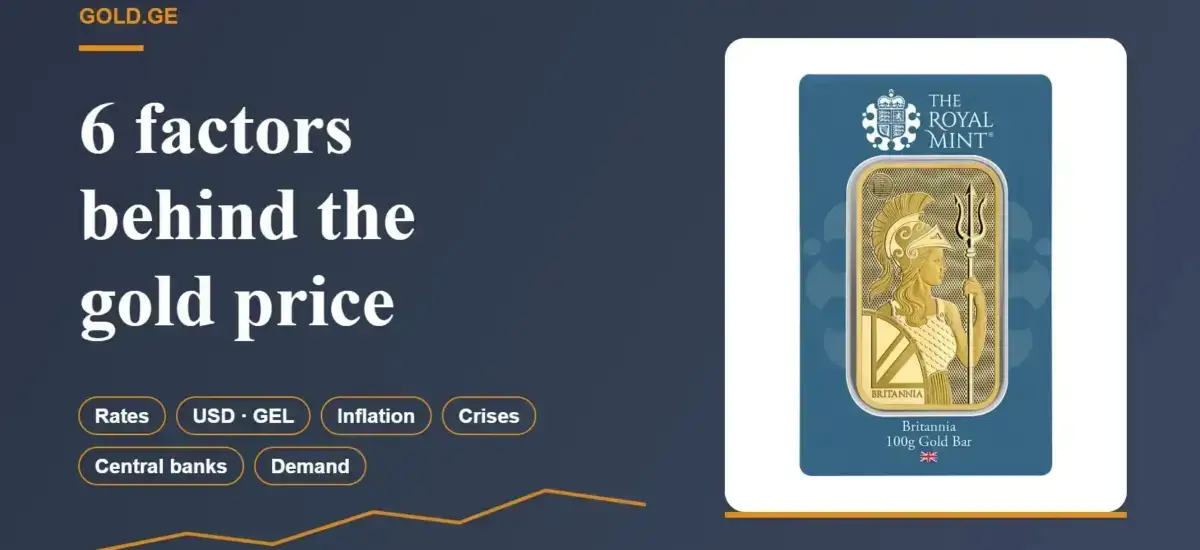
Our gold prices refresh roughly every 10 seconds and almost never sit still. Here is what drives the gold price, the six forces behind every move, and which of them have been doing the pushing this autumn.
“It was cheaper yesterday. Why is it different today?” We hear that at the counter almost every day, and more than ever right now. On 30 October gold dropped more than 3% in a single session, then slowly clawed some of it back.
There is no single answer. Several forces pull on the price at once, sometimes in opposite directions. Below are the six that matter most, with examples from the last few weeks. At the end we show how they turn into the number you see on our gold price page.
01Interest rates: the biggest lever
Gold pays no interest. A bar sits in a safe and that is it. A deposit or a US Treasury bond, on the other hand, pays you every year.
So when rates are high, or markets expect them to rise, holding gold gets “expensive”. Big funds move part of their money to where it earns a yield. When rates fall, the opposite happens and gold looks more attractive.
October was a textbook case. The US Federal Reserve held rates at the end of the month but signalled that tightening isn’t over, and economists now expect a hike in December. Gold finished October sharply lower.
Source: Kitco / Reuters, 30 October 2026.
02The dollar, and in Georgia the lari too
Gold is priced in dollars worldwide. When the dollar strengthens, gold gets more expensive for anyone holding euros, yen or rupees, so fewer people buy. That is why a strong dollar usually pushes gold down.
In Georgia there is one more layer: the lari exchange rate. The lari price is simply the dollar price per ounce times the exchange rate. So gold can be flat on world markets and still move here, purely because the lari got stronger or weaker.
For reference, on the morning of 4 November one gram of 999.9 gold costs $126.66, or 332.86 GEL.
03Inflation and oil: not always a tailwind
Many people buy gold as an inflation hedge. The logic is sound: money loses value, metal doesn’t. Over long periods that often holds.
Over a few weeks it can work the other way, and October showed it. An attack on a tanker in the Strait of Hormuz lifted oil, and pricier gasoline pushed up US inflation for September. Markets read it as: inflation is high, so the Fed will hike, so gold is less appealing.
This time, inflation made gold cheaper. That is why you can’t look at any of these factors on its own. They are all wired together.
04Fear, wars and crises
War, sanctions, a banking scare. At times like these people look for something that depends on neither a bank nor a government. Gold has played that role for thousands of years, and demand usually climbs when tension does.
There is a catch, though. Once panic hits the stock market, some investors need cash fast to cover losses, and gold is one of the quickest things to sell. So in the first days of a crisis, gold can fall too. Analysts partly blame the 30 October drop on a sell-off in tech stocks. We covered it in our October review.
05Who buys by the tonne: central banks and funds
Central banks buy gold for their reserves, and lately they have been buying a lot. According to the World Gold Council report of 3 November, they bought 321 tonnes in Q3 2026, 42% more than a year earlier. Year to date, that adds up to 675 tonnes.
In the same quarter, gold ETFs took in 211 tonnes, after money had flowed out the quarter before.
Buyers this size don’t move the price in a day, but they put a floor under it. They can’t always stop a slide, as October proved.
Source: World Gold Council, Gold Demand Trends Q3 2026.
06Jewellery, bars and mines
Finally, plain supply and demand. The biggest buyers of physical gold are India and China, mostly for jewellery.
When gold is expensive, many of them hold off. In Q3, jewellery demand fell 17% and bar and coin demand fell 19%. Mines, meanwhile, produced 1,071 tonnes, a record for a third quarter.
Supply changes slowly, since a new mine takes years to open. So this factor works over months and years rather than day to day.
07What you actually pay: market price plus premium
All six factors change one thing: the market price. A bar’s price has one more part, the premium. That is the gap between the bar’s price and the value of the gold inside it.
Bar price = price per ounce in $ × exchange rate × weight + premium
The market price changes every few seconds. The premium depends mostly on the size of the bar.
The smaller the bar, the bigger the premium. Today’s numbers from our site:
| Bar | Price | Premium |
|---|---|---|
| 1 g, C. Hafner | 418.73 GEL | +20.5% |
| 10 g, C. Hafner | 3,594.74 GEL | +7.4% |
| 1 oz (31.1 g), C. Hafner | 10,772.78 GEL | +3.9% |
| 100 g, Royal Mint Britannia | 34,602.53 GEL | +3.8% |
Source: gold price on Gold.ge, 4 November 2026, 08:37. Prices change.
On a large amount the difference is real money. With 100,000 GEL you get roughly 83,000 GEL worth of gold in 1 g bars, and roughly 96,300 GEL worth in 100 g bars. For bigger allocations, 1 kg bars are available on order and collected in store. Companies can pay by bank transfer against an invoice.
One more thing. Nobody controls the market price, but you choose when to buy. When you pay online, the price is locked at the moment of payment. This is an explanation, not investment advice.
→ gold price · gold bars · gold coins · how large investors buy gold
08Questions we get asked most
How often does the gold price change?
On trading days the world price moves almost continuously. Gold.ge prices refresh about every 10 seconds, and when you pay online the price is locked at the moment of payment.
If the dollar goes up, does gold go up too?
In lari, all else equal, yes: the lari price is the dollar price times the exchange rate. But a strong dollar often pushes the world dollar price of gold down, so the two effects partly cancel out.
Does gold always rise with inflation?
No. Over the long run gold often holds its value, but in the short run high inflation can raise expectations of rate hikes and make gold cheaper. That is what happened in October 2026.
Why does a gram cost more in a 1 g bar than in a 100 g bar?
Small bars carry a higher premium. Today on Gold.ge it is 20.5% on a 1 g bar and 3.8% on a 100 g bar, so larger sums go further in larger bars.
If the price drops, will you buy my gold back?
Yes, if the bar or coin was bought from Gold.ge. The buyback price is based on the market price minus a margin, so a short-term loss is possible. We do not buy jewellery or gold bought elsewhere. Contact us for today’s price.
See what gold costs right now
Check the live price, choose a bar or coin online and collect it at one of our stores in Tbilisi: Galleria Tbilisi (2/4 Shota Rustaveli Ave) or Radisson Blu Iveria. Paying with Keepz carries no commission.
Gold price todayBars and coinsContact