



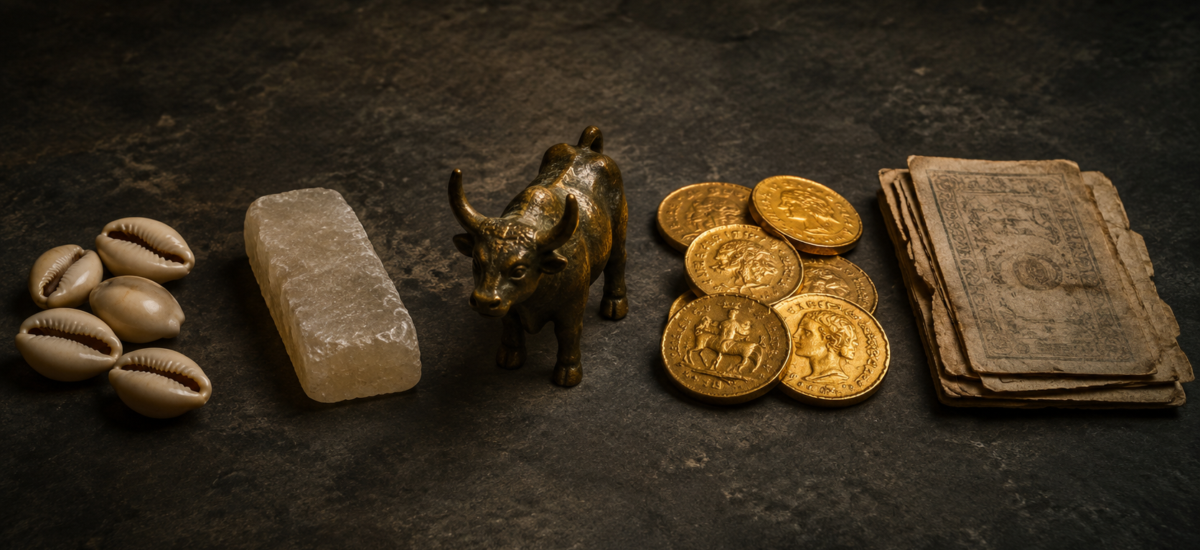
For thousands of years, humanity tested one form of money after another, each chosen for the same reason: it was hard to make more of. Gold won that contest decisively. Then, in a single century, we abandoned the winner. This is the story of how, and why.

01What made something “hard”
Money is the strangest of goods: we accept it not because we want it, but because we trust that someone else will accept it from us later. That trust rests on one fragile property above all others — scarcity that cannot easily be faked or flooded. Economists capture this with the idea of hardness: money is “hard” when its supply is difficult and costly to increase, and “easy” when new units can be produced cheaply and quickly. The whole of monetary history is, at heart, a search for the hardest money available — and a series of painful lessons about what happens when that hardness fails.
The measure that makes this precise is the stock-to-flow ratio: the size of the existing stockpile divided by the amount newly produced each year. A high ratio means yearly production is trivial next to what already exists, so no producer can suddenly double the supply and destroy its value. This single number, more than beauty or utility, decided which monies survived and which collapsed. As we walk through the great experiments of history, watch that ratio: every money that failed as a store of value failed because someone found a way to make more of it, faster than anyone expected.
02The great experiments — and how each one broke
Before metals, before coins, dozens of societies independently invented money out of whatever was scarce and durable in their world. Four cases show the pattern most clearly — and each ended the same way.
Cattle: the money that could breed
Among the oldest forms of wealth-money was livestock. Cattle were valuable, universally desired, and self-transporting — they walked to market. The word “pecuniary” descends from the Latin pecus, cattle; “capital” from caput, a head of cattle. But livestock made a poor store of value for obvious reasons: cattle are not divisible (you cannot pay half a cow), not uniform (one ox differs from another), and worst of all, they reproduce. A money that breeds is a money whose supply expands on its own — the opposite of hardness. Cattle worked as a unit of wealth precisely where transactions were rare and large; they failed the moment an economy needed everyday exchange.
Cowrie shells: the world’s most successful early currency — until the ships came
The cowrie shell was the most widely and longest-used currency in human history, circulating across Africa, South Asia, and East Asia for well over a thousand years. Shells were durable, portable, hard to counterfeit, and — crucially — genuinely scarce in the inland regions that used them, because they came only from specific Indian Ocean and Pacific shores. For centuries their stock-to-flow was high, and they held value beautifully.
Then technology changed the flow. When European trading ships gained the ability to import cowries by the shipload from the Maldives to West Africa, the supply that had taken nature centuries to distribute could suddenly be dumped in years. The predictable result: the shells inflated and collapsed as money. Cowries are the first great lesson of monetary history — a money is only as hard as the hardest way to obtain more of it, and technology can turn a scarce good into an abundant one almost overnight.
Salt: money you could tax, trade — and mine
Salt was money and more: essential for preserving food, universally needed, and used to pay workers across the ancient world. The claim that Roman soldiers were paid in salt is likely a romantic exaggeration, but the linguistic fossil remains — “salary,” from the Latin salarium. In parts of Africa, salt bars traded directly against gold dust. Yet salt shared the fatal weakness of all mineable commodities: as mining and transport improved, more of it could be produced, and its stock-to-flow stayed stubbornly low. Salt could store value only where it was hard to get; wherever it became easy to get, it stopped being money.
Metals: the turning point
The decisive move in monetary history was the shift to metals — copper, bronze, silver, and gold. Metals solved the problems that broke earlier monies at a stroke: they are durable (they don’t rot, die, or spoil), divisible (a bar can be cut, melted, and reformed without losing value), uniform (an ounce of pure gold is identical to any other), and portable relative to their worth. Above all, metals were naturally scarce — you could not breed them like cattle or ship them in like shells; you had to dig them out of the earth at real cost. Money had found its material. The only question left was: which metal?
03Why gold won
Silver, copper, and bronze all served as money for millennia, often alongside gold. But over the long run, gold pulled ahead and stayed ahead, and the reason is written in its physical properties.
Gold has the highest stock-to-flow of any metal — around 60, meaning it would take some sixty years of mining at current rates to reproduce all the gold that already exists above ground. Silver’s is roughly 20; base metals far lower. That single fact made gold the hardest money nature offered: no gold rush, no new mine, no technological leap has ever increased the world’s gold supply by more than about 1.5–2% in a year. A holder of gold could sleep knowing that no one could suddenly conjure more of it and dilute their savings.
Gold had a second, subtler advantage: it is chemically almost inert. It does not tarnish, rust, or react, so it never needed to be consumed or renewed — every ounce ever mined still exists, accumulating into that enormous stock that makes new mining trivial by comparison. Silver tarnishes and gets used up in industry; copper corrodes. Gold simply endures, and its endurance is precisely what makes its stock-to-flow so high. The metal’s uselessness for anything practical was, paradoxically, its greatest monetary virtue: because almost no gold is consumed, almost all of it survives as monetary stock.
By the classical age the verdict was in. Lydia struck the first standardised gold coins around 600 BC; Rome, Byzantium, the Islamic world, and medieval Europe all built their monetary systems on gold and silver. For the next 2,500 years, gold was the benchmark against which every other money was measured — the anchor of trade, the reserve of empires, the money that outlived the states that minted it.

04The oldest attack: debasing the winner
Here the story takes its darkest and most repeated turn. Gold and silver were hard to mine — but once a ruler held them, there was a tempting way to create money from nothing: debasement. Take the existing coins, melt them, mix in cheaper base metal, and strike a larger number of coins of the same face value. The ruler pockets the difference. The money supply expands. And the coins in everyone’s purse quietly become worth less. This is inflation in its most ancient and literal form — and it is the Austrian economists’ central warning made flesh: whoever controls the money will, over time, be tempted to make more of it, because the gain is immediate and theirs, while the loss is slow and everyone’s.
Rome: the aureus and the dying denarius
The Roman Empire is the textbook case. The silver denarius, the backbone of Roman commerce, began as nearly pure silver under the early emperors. As the costs of empire mounted — armies to pay, frontiers to defend, a bureaucracy to feed — successive emperors reduced its silver content, coin by coin, reign by reign. By the third century AD the denarius had collapsed from around 98% silver to under 5% — a thin silver wash over a base-metal core. The gold aureus was shaved too: its weight was cut repeatedly until Diocletian and Constantine were forced to reform the coinage entirely. The result was one of history’s first great inflations, a spiral of rising prices and collapsing confidence that helped unravel the Roman economy from within.
The medieval sequel: clipping and sweating
When rulers debased from above, ordinary people learned to debase from below. Because medieval gold and silver coins were valued by their metal content, a coin’s worth lay in its weight — so people clipped them, shaving tiny slivers of metal from the edges, and sweated them, shaking coins in a bag to collect the dust that rubbed off. A clipped coin still passed at face value, but carried less metal; melt down the clippings and you had free silver. So widespread was the practice that it corroded trust in every coin — you never knew if the one handed to you was full weight. The eventual technical fix was elegant: milled (reeded) edges, the ridged rims still on coins today, which made clipping instantly visible. Isaac Newton, as Master of the Royal Mint, waged a famous campaign against clippers and counterfeiters. But the deeper lesson stood: even the hardest money can be softened by those who handle it, whether emperor or forger.
Notice what debasement and clipping really were: attempts to inject the “easy money” logic into a hard-money system. They were fiat impulses inside a gold world — the desire to create spending power without creating value. For two thousand years, hard money resisted these attacks imperfectly but stubbornly, because at the end of the day the metal was still the metal, and a clipped coin could be weighed. What finally broke the discipline was not a sharper knife. It was an idea: that money need not be the metal at all.

05From metal to paper: the fateful convenience
The road to fiat did not begin with a conspiracy. It began with a convenience. Carrying and guarding large amounts of gold was heavy and dangerous, so goldsmiths and early banks began issuing paper receipts for gold held in their vaults. The paper was easier to carry than the metal, and because everyone knew it could be redeemed for gold on demand, people began trading the receipts themselves instead of withdrawing the gold. Paper money was born — and at first, it was honest paper: every note a claim on a specific weight of metal.
But the receipts contained a temptation as old as debasement. A banker holding gold for a hundred customers noticed that they rarely all came for their gold at once. So he could issue a few more receipts than he had gold to back — lending them out, earning interest — and as long as confidence held, no one would notice. This is the origin of fractional-reserve banking, and of the recurring bank runs that punctuate financial history: the moment too many people demanded the metal at once, the paper promises exceeded the gold, and the system cracked.
Governments formalised the paper system into the gold standard: national currencies defined as fixed weights of gold, notes redeemable on demand, exchange rates fixed because every currency was tied to the same metal. Under the classic gold standard of the late 19th century, the discipline of gold still ruled — a government could not print more money than its gold reserves allowed. That discipline gave the era remarkable price stability and underwrote the first great age of global trade. But it was also, from a government’s point of view, a cage. And the 20th century would be spent breaking out of it.
06Why inflation pushed the world to fiat
The gold standard’s great virtue and its fatal flaw were the same thing: it would not let governments create money at will. When a state needed to fund something its taxes could not cover — above all, war — gold said no. You cannot fight a world war on a fixed money supply without either raising crushing taxes or borrowing beyond your gold. So, one crisis at a time, governments chose to loosen the chain.
The pattern is consistent and, to the Austrian eye, entirely predictable. In 1914, to finance the First World War, the combatant nations suspended gold convertibility and printed. They intended it as temporary; the discipline never fully returned. The interwar attempt to rebuild the gold standard collapsed in the Depression, and in 1933 the United States recalled private gold and devalued the dollar against it. In 1944, Bretton Woods rebuilt a diluted version — the dollar tied to gold, other currencies tied to the dollar — but now the metal anchored the system at one remove, and only foreign governments, not citizens, could redeem dollars for gold.
The final break came in 1971. Facing a drain on American gold reserves as dollars piled up abroad, President Nixon suspended the dollar’s convertibility into gold “temporarily.” It was never restored. In 1976 the change was formalised, and gold was officially demonetised in the international system. For the first time in human history, the entire world ran on money backed by nothing physical at all — money that exists purely by government decree. Fiat: “let it be done.”
Why does this matter, and why do the Austrian economists — Ludwig von Mises, Friedrich Hayek — treat 1971 as a warning rather than a liberation? Because their central insight is precisely the lesson of Rome, of the clippers, of the over-issuing goldsmith: a monopoly issuer of money faces a permanent incentive to create more of it. The benefit of printing is immediate and concentrated — the government spends first, at today’s prices. The cost is delayed and diffuse — everyone’s savings erode slowly, and few connect the loss to its cause. Under a gold standard, that incentive runs into a wall of metal. Under fiat, there is no wall. The debasement that took Rome two centuries of furtive metallurgy can now be accomplished in an afternoon, and legally.
07What the long story teaches
Step back and the five-thousand-year arc has a shape. Humanity tried cattle and shells and salt and settled on metals; among metals it chose gold, because gold was the hardest — the one money no one could cheaply multiply. For two millennia the enemies of hard money attacked it from inside, through debasement and clipping, and hard money mostly held, because the metal was still the metal. Then paper offered a convenience that slowly became a temptation, and in the 20th century, one war and one crisis at a time, the world cut the anchor entirely and embraced money that can be created without limit. We did not abandon gold because it failed. We abandoned it because it worked too well at the one thing governments sometimes wish money would not do: refuse to be printed.
Whether that was progress or a mistake is one of the great debates of economics, and reasonable people disagree. Fiat money is flexible in ways a gold standard is not, and that flexibility has real uses in a crisis. But the historical record is not ambiguous about the cost of that flexibility: since 1971, every unbacked currency on Earth has lost the majority of its purchasing power, exactly as the denarius did, exactly as the cowrie did when the ships came. The names change — emperor, clipper, central bank — but the mechanism is identical: someone found a way to make more of the money.
This is why gold, demonetised and dismissed, refuses to disappear. Central banks — the very institutions that issue fiat — hold tens of thousands of tonnes of it and have lately been buying more. Individuals return to it whenever confidence in paper wavers. Not because gold is mystical, but because it remains what it has always been: the hardest money humanity ever found, the one form of wealth that no decree can print into abundance. In a world of unlimited money, the appeal of the one money that cannot be multiplied is not nostalgia. It is arithmetic.
The whole history above is, in the end, the reason anyone still buys physical gold today. It is not a bet that the fiat experiment will end tomorrow. It is a recognition that across every civilisation that ever tried, the money that stored value best was always the money that was hardest to make — and that, five thousand years on, still means gold you can hold in your hand.
Notes & sources
- Stock-to-flow framework and gold’s ratio (~60) vs silver (~20): standard commodity-monetary analysis; World Gold Council data on above-ground stocks (~210,000 t) vs annual mine supply (~3,600 t).
- Cattle and salt as money; etymologies of “pecuniary” (Latin pecus), “capital” (caput), and “salary” (salarium). Standard economic and linguistic history; the Roman-soldiers-paid-in-salt claim is considered largely apocryphal.
- Cowrie shells as long-lived global currency and their inflation following bulk European maritime importation. Numismatic and economic-history sources.
- Debasement of the Roman denarius from near-pure silver to under ~5% by the 3rd-century crisis; repeated reduction of the gold aureus; Diocletian and Constantine coinage reforms. Standard Roman monetary history; figures approximate and illustrative.
- Medieval coin clipping and sweating; introduction of milled/reeded edges as a countermeasure; Isaac Newton as Master of the Royal Mint. Numismatic history.
- Origins of paper receipts, fractional-reserve banking, the classic gold standard, and the 20th-century transition: 1914 wartime suspension, 1933 US gold recall, 1944 Bretton Woods, 1971 Nixon suspension of dollar-gold convertibility, 1976 formal demonetisation. Standard monetary history.
- Austrian monetary theory on the incentive of a monopoly money-issuer to inflate: Ludwig von Mises, “The Theory of Money and Credit” (1912); Friedrich Hayek, “The Denationalisation of Money” (1976).
- US dollar purchasing-power decline since 1971 based on US Bureau of Labor Statistics CPI. Approximate; the dollar has lost the great majority of its 1971 purchasing power.
This article is educational commentary on monetary history and theory, not investment, legal, or tax advice. Historical figures are approximate and illustrative. Assess your own situation or consult a qualified adviser before acting.