



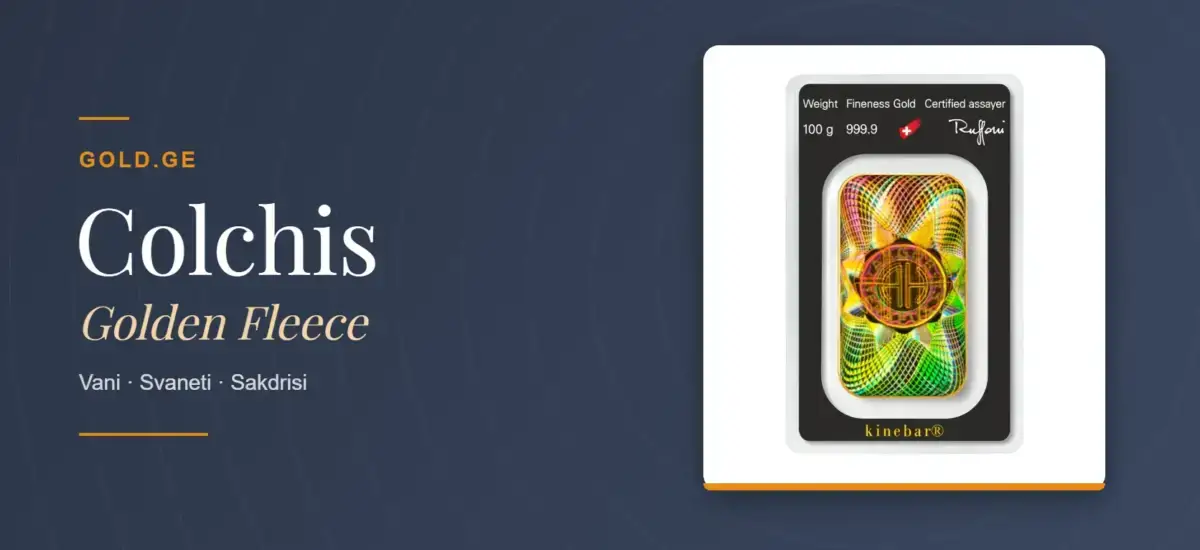
The Golden Fleece is a Greek myth, but the gold of Colchis was real. Here is what we actually know about it, where that knowledge comes from, and where in Georgia you can see it for yourself.
Visitors from abroad often ask us in the shop: “So Georgia is the land of the Golden Fleece?” It is. To the ancient Greeks, Colchis, on the eastern shore of the Black Sea in what is now western Georgia, was a place rich in gold. But the myth and the history are not the same thing, and the history is the better story, because archaeologists and geologists have been able to check it.
We stick to what the sources support here. Where it is still legend, we say so.
01First, the myth
Jason sails the Argo to Colchis to take the Golden Fleece from King Aeëtes, and the king’s daughter Medea helps him do it. That is the story most people know.
The fullest version to survive is the Argonautica by Apollonius of Rhodes, written in Alexandria in the mid-third century BC. The legend itself is much older, though nobody can say exactly how old.
What matters is that the Greeks pictured Colchis as a land of gold. That idea had to come from somewhere.
02What Strabo saw in the mountain rivers
By the first century BC the Greek geographer Strabo was describing a practice rather than a myth. Mountain torrents, he wrote, carry gold down, and the locals collect it using perforated troughs and fleecy skins. That, in his view, was where the Golden Fleece story came from.
The method is simple. A sheepskin is laid in the stream, the water washes the sand through, and the heavy flakes of gold catch in the wool. Dry the skin, shake it out, and you have your gold. A fleece glittering with it is not hard to imagine.
Source: Golden Fleece, Wikipedia (citing Strabo’s Geography and Apollonius).
03Geologists went and checked
In 2014 Avtandil Okrostsvaridze, a geologist at Ilia State University in Tbilisi, and his colleagues studied the rivers of Svaneti in north-western Georgia. Their paper appeared in Quaternary International.
They analysed more than 1,000 samples. They also found that the sheepskin method is still in use: whole skins are laid on stream beds 100 to 500 metres from gold deposits. The team estimated that the bedrock along Svaneti’s main river system holds 65 to 70 tonnes of gold.
So the Golden Fleece looks less like fantasy and more like an old mining technique that the Greeks turned into a legend.
Source: Science News, 2014.
04Vani, where Colchis gold came out of the ground
Fleeces were not the whole story, and the ancient city of Vani in the Imereti region proves it. It sits on a hilltop and was lived in from the eighth century BC until the middle of the first century BC.
Ekvtime Takaishvili made the first excavations in 1896, and regular digs began in 1966 under Otar Lordkipanidze. Rich burials from roughly 450 to 250 BC held finely made gold jewellery by local goldsmiths. Those finds are what turned Colchis’s golden reputation from a story into evidence.
Vani gold has travelled to major museums abroad, including the Getty in Los Angeles. At home it is kept at the Vani Archaeological Museum and the Georgian National Museum in Tbilisi. If you are visiting Tbilisi, go and see it.
Sources: Vani archaeological site, Wikipedia · J. Paul Getty Museum.
05Sakdrisi: gold older than Colchis
Gold was being mined in Georgia long before Vani. At Sakdrisi, in the Kvemo Kartli region, a Georgian and German team studied ancient mine workings between 2004 and 2011. They date to the second half of the fourth millennium or the early third millennium BC.
Sakdrisi is often described as one of the oldest known gold mines in the world. The finds are on display at the Bolnisi Museum.
Source: Sakdrisi, Wikipedia.
06At a glance: what, when and where to see it
| Period | What we know | Where to see it |
|---|---|---|
| 4th–3rd millennium BC | Sakdrisi gold mine workings | Bolnisi Museum |
| 8th–1st century BC | Vani and Colchian goldwork | Vani Archaeological Museum, Georgian National Museum |
| 3rd century BC | The Argonautica of Apollonius of Rhodes | Text |
| 1st century BC | Strabo on gold and fleeces | Text |
| 2014 | Geological study of Svaneti’s rivers | Quaternary International |
For the wider story of gold, from Egypt to the gold standard, we have a separate piece.
→ The oldest money: a short history of gold · Gold during a crisis: what history shows
07And today? Gold you can hold
Colchian gold belongs in museums. Gold people buy today comes as bars and coins, stamped by a known refinery with an exact fineness. Our bars are 999.9 fine, from Valcambi, PAMP, Argor-Heraeus, C. Hafner, Royal Mint Britannia and others.
A few real prices from the morning of 23 November: a 1 g C. Hafner bar was 383 GEL and a 100 g Argor-Heraeus bar 31,650 GEL, about 317 GEL a gram. Small bars cost more per gram, which is fine for a souvenir or a gift but worth knowing. Prices follow the market and update on the site roughly every 10 seconds. You can follow the live gold price on its own page.
To be plain about it: gold goes down as well as up, and history does not guarantee future returns. We buy back only bars and coins bought from Gold.ge, at the market price minus a margin. We do not buy jewellery or gold bought elsewhere.
→ Gold bars · Gold coins · Contact
08Questions we get asked
Was the Golden Fleece real?
The story is a myth. But Strabo, in the first century BC, describes people collecting river gold with sheepskins, and the method is still used in Svaneti today. Many researchers see that as the root of the legend.
Where can I see Colchis gold in Georgia?
At the Vani Archaeological Museum and the Georgian National Museum in Tbilisi. Finds from the Sakdrisi mine are at the Bolnisi Museum.
Is there still gold in Svaneti?
A 2014 geological study estimated 65 to 70 tonnes of gold in the bedrock along Svaneti’s main rivers. That is a scientific estimate, not a figure for commercial mining.
Can I buy Georgian or Colchian gold from you?
No. We sell 999.9 bars from internationally known refineries, plus investment and historic coins. Archaeological gold belongs in museums.
How much is the smallest gold bar?
On the morning of 23 November a 1 g bar at Gold.ge started at 383 GEL. The price moves with the market, so check the site for today’s figure.
Colchis gold is in the museum. Yours can be here
Browse bars and coins online or visit our shops at Galleria Tbilisi (2/4 Shota Rustaveli Ave) and Radisson Blu Iveria. Paying online locks the price, and Keepz has no commission. Orders are collected in store.
Gold barsAll productsGold price today