



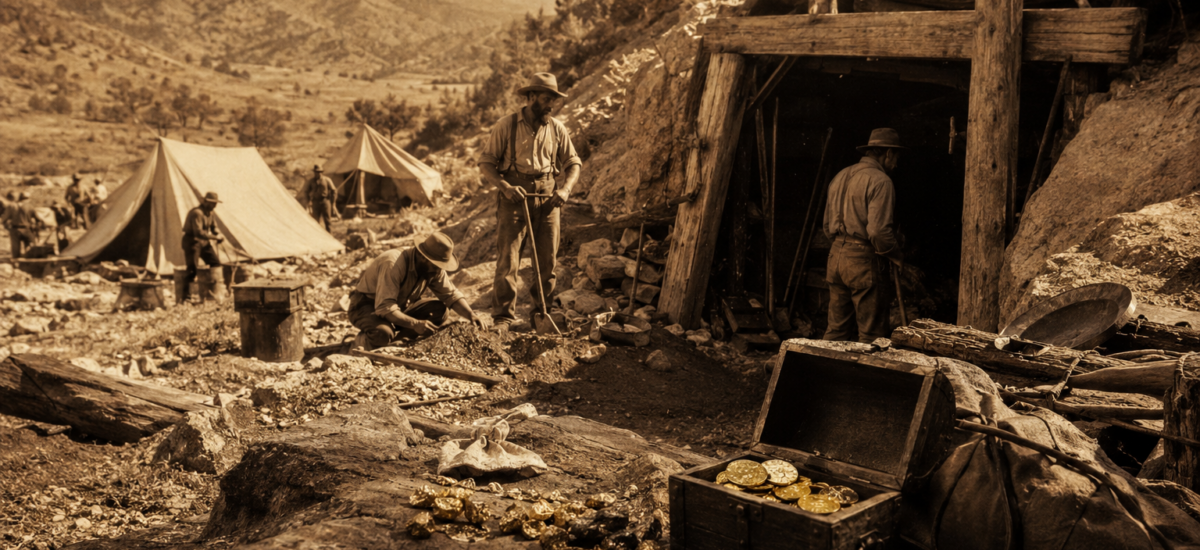
For more than five thousand years, across empires that shared no language and no border, humanity kept arriving at the same conclusion about what wealth should be made of.

01Why this metal, of all of them
Of the ninety-odd elements that occur naturally on Earth, humanity settled on one to store its wealth — and it was not an accident of taste. Gold is chemically almost inert: it does not rust, tarnish, or corrode, so a coin buried for two thousand years emerges as bright as the day it was struck. It is rare enough to be precious but common enough to circulate. It is dense and unmistakable, hard to counterfeit and easy to verify. It melts at a low enough temperature to be worked with ancient fire, and it is soft enough to divide yet durable enough to survive.
Long before anyone reasoned about monetary theory, these physical properties did the reasoning for them. A society looking for something to hold value across a lifetime — across generations — kept converging on the same answer. Salt, cattle, shells, grain and copper all served as money somewhere, but each rotted, died, bred, or rusted. Gold simply endured. That endurance is the whole story: the metal outlasts the hand that mines it, the mint that stamps it, and usually the empire that spends it.
02Before coins: treasure and ornament
The oldest worked gold known to archaeology comes from the Varna necropolis on the Black Sea coast of modern Bulgaria, buried around 4,500 BC — grave goods more than six thousand years old, crafted long before the wheel or writing.1 In Egypt, gold was the flesh of the gods and the currency of the afterlife; the tomb of Tutankhamun alone yielded a funerary mask of some eleven kilograms of solid gold. For these early societies gold was not yet “money” in the transactional sense. It was stored value, status, and the sacred — a way to concentrate wealth into something portable, permanent, and universally desired.

03Lydia and the birth of the coin
The decisive leap came around 600 BC in Lydia, a kingdom in what is now western Turkey. There, under kings whose wealth gave us the phrase “rich as Croesus,” the first standardised coins were struck — first from electrum, a natural gold-silver alloy panned from the river Pactolus, then, under Croesus himself, from refined gold and silver separately.2 The innovation was not gold; it was the stamp. A mark from the sovereign certified weight and purity, so metal no longer had to be weighed and assayed at every transaction. Value became countable. Trade accelerated. Within a century the idea had spread across the Greek world and beyond, and money as we recognise it was born.
04Rome, Byzantium and the coin that lasted a thousand years
Rome made gold coinage an instrument of empire. The aureus paid the legions and greased a trade network stretching from Britain to the Persian frontier. But Rome also taught the first great monetary lesson in debasement: as the empire strained, emperors quietly shaved the precious-metal content of their coins, and the silver denarius in particular collapsed from nearly pure to almost worthless base metal over two centuries — an early, vivid demonstration that a currency is only as sound as the discipline of those who issue it.
The eastern empire drew the opposite lesson. The Byzantine solidus, introduced by Constantine around AD 300, held its gold weight almost unchanged for some seven hundred years — the longest-lived stable currency in recorded history, trusted from the North Sea to the Indian Ocean.3 Its reliability was itself a form of power. Where Rome debased and decayed, Byzantium kept its coin honest and outlasted the West by a millennium.
05Gold moves the world
For the next thousand years gold pulled history behind it. Medieval West Africa — the empire of Mali and its legendary ruler Mansa Musa — supplied much of the Old World’s gold across the Sahara; Musa’s pilgrimage to Mecca in 1324, so lavish it reportedly disrupted gold prices in Cairo for years, made him a byword for wealth to this day. Centuries later, the hunt for gold drove European ships across oceans: the Spanish conquest of the Americas was, in large part, a search for it, and the galleons that carried Aztec and Inca gold back across the Atlantic reshaped the global economy — and triggered one of history’s first great inflations when too much metal chased too few goods.
Then came the rushes. California in 1849, Australia in 1851, the Klondike, South Africa’s Witwatersrand — each pulled hundreds of thousands of people across the world and built cities where there had been none. Gold did not just measure wealth; it moved populations, drew borders, and founded nations.

06The Land of the Golden Fleece
No history of gold is complete here without Georgia. To the ancient Greeks, the kingdom of Colchis — in what is now western Georgia — was the mythical land “bursting with gold,” the destination of Jason and the Argonauts in their quest for the Golden Fleece. That legend has a real root: for millennia, Georgians in the mountain rivers of Svaneti trapped fine gold particles by submerging sheepskins in the current, then drying and beating them to release the metal. A fleece heavy with river gold was no myth — it was a mining technique, and quite possibly the true “Golden Fleece.”
The goldsmiths of Colchis were among the most skilled in the ancient world, working granulation and filigree at Vani centuries before such techniques spread across Europe. Later, the Georgian Golden Age left its own coinage: David IV the Builder issued reformed money after taking Tbilisi in 1122, and Queen Tamar’s bronze coins — bearing Georgian and Arabic inscriptions naming her “Champion of the Messiah” — remain prized to this day. Gold has been woven into this land’s identity for five thousand years.

07The gold standard: money anchored to metal
By the 18th and 19th centuries, gold moved from being money itself to being the anchor of money. In 1717, Sir Isaac Newton — as Master of the Royal Mint — set the price of gold in a way that effectively placed Britain on a gold standard, and by the 1870s most of the industrial world had followed. Under the classic gold standard, paper notes were promises: each one redeemable for a fixed weight of gold on demand. Currencies had fixed values against each other because each was defined in gold, and this stability underwrote the first great age of globalised trade.
The system’s virtue was discipline — a government could not print more money than its gold reserves allowed. That was also its constraint, and in the upheavals of the 20th century, one crisis at a time, that constraint was loosened.
08The 20th century: cutting the anchor
The classic gold standard did not die in a single day. It was severed in stages, each under the pressure of war or crisis, until the link between money and metal was gone entirely.
- 1914
The Great War suspends gold. To finance the fighting, the combatant nations suspended gold convertibility and printed. The classic gold standard, and the stable world it underwrote, never fully returned.
- 1933
The US recalls private gold. Executive Order 6102 required Americans to surrender gold to the state; the dollar was then devalued against it. Domestic money and metal were formally divorced.
- 1944
Bretton Woods. A new order: the US dollar was fixed to gold at $35 an ounce, and other currencies were fixed to the dollar. Gold still anchored the system — but now at one remove.
- 1971
The Nixon shock. Facing a drain on US reserves, President Nixon suspended the dollar’s convertibility into gold “temporarily.” It was never restored. For the first time in history, the world’s money was backed by nothing but trust.
- 1976
The fiat era is formalised. The Jamaica Accords ratified floating exchange rates and demonetised gold in the international system. Officially, gold was no longer money.
And here is the twist the textbooks often understate: gold’s demonetisation was never quite complete. The world’s central banks — the very institutions that cut the link — kept their gold. They hold it still, tens of thousands of tonnes of it, and in recent years they have been buying more, not less. A metal officially retired from money remains, quietly, the asset that monetary authorities trust when they trust nothing else.
09Why gold still matters
Half a century into the fiat experiment, gold has not behaved like a relic. Freed from a fixed price, it rose from $35 an ounce in 1971 to above $5,000 in early 2026 — not because gold “grew,” but because the currencies measuring it shrank. Across that same span, every unbacked currency lost the great majority of its purchasing power. Gold’s role quietly inverted: once the anchor of money, it became the hedge against money.
The reasons people hold gold today are the same reasons the Lydians stamped it, Byzantium trusted it, and central banks still vault it. It is no one’s liability. It cannot be printed. It has never gone to zero in five thousand years, and it has outlived every currency ever issued against it. Modern portfolios hold it for the oldest reason there is: as the one form of wealth that does not depend on anyone’s promise.

10Five thousand years, one conclusion
Empires rose and fell. Coins were struck, clipped, debased and forgotten. Paper monies were invented, inflated, and abandoned by the hundreds. Through all of it, one substance kept its meaning: a soft, bright, nearly indestructible metal that humans across every civilisation, with no way to consult one another, independently decided was worth preserving.
That is the short history of gold — and, quite possibly, a preview of its future. The fiat experiment is barely two generations old. The metal it replaced is fifty centuries deep. History does not guarantee tomorrow, but when something has held human trust for five thousand years, the burden of proof sits with those who bet against it.
Notes & sources
- The Varna Chalcolithic necropolis (c. 4560–4450 BC), Bulgaria — the oldest large hoard of worked gold known to archaeology. National Museum of History, Sofia.
- Lydian coinage under Alyattes and Croesus (c. 600–546 BC); the transition from electrum to bimetallic gold-and-silver coinage. British Museum collections.
- The Byzantine solidus retained a stable gold content (~4.5 g) from Constantine (c. AD 309) into the 11th century — among the longest-lived stable currencies recorded.
- Gold price history and central-bank holdings: World Gold Council; LBMA. 2026 figure reflects spot trading above $5,000/oz in early 2026. Values are approximate and indexed for illustration.
This article is educational and historical commentary, not investment advice. Gold prices are volatile and past performance does not guarantee future results. Assess your own situation or consult a qualified adviser before acting.